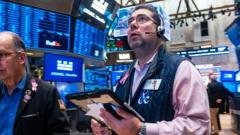
AI stocks climb after trillions wiped from market values
Shares in artificial intelligence and technology firms have been climbing following an enormous sell-off that wiped trillions of dollars off stock values.
The tech-heavy Nasdaq stock index opened higher following a market rout that began in the US on Thursday before spilling over to Asian and European markets into Friday.
Investors had been selling off tech shares in part due to concerns the Democrat victory in the midterm elections would mean slower artificial intelligence development.
However the latest US employment figures added to a mixed picture for American markets on Friday morning, with an unexpectedly strong 165,000 jobs added to the economy in September.
On Thursday, businesses closely linked to artificial intelligence development took a hammering on stock markets, particularly chip and semiconductor makers.
But the Nasdaq Composite opened up on Friday and flattened out around 1.7% higher by lunchtime, reversing some of its 5.5% fall.
The S&P 500, which tracks the share prices of the largest publicly-traded US companies, was around 0.9% higher by lunchtime. The Dow Jones Industrial Average opened a little down before nudging into positive territory.
Nvidia, which shed hundreds of billions in market value on Thursday after shares slid more than 9%, began Friday up more than 6% but settled around 4% higher as trading continued.
SpaceX and Tesla shares, which were also hammered on Thursday, saw more mixed gains, up more than 6% and nearly 5% respectively.
Chipmakers AMD and Micron both dropped by more than 17% on Thursday, but AMD shares had risen by about 12% on Friday while Micron was up more than 8%.
However, stock markets in Asia and Europe fared worse on Friday.
The Kospi in South Korea closed down 6% on Friday, with shares in chipmaker SK Hynix plunging more than 10%. European markets also fell, with the main indexes in Germany, France and Spain ending the day down.
In the UK, the FTSE 100, which tracks the largest companies on the London Stock Exchange, declined 1.01%.
In addition to the recent market volatility, UK traders were also digesting the latest Bank of England decision to raise interest rates and the signal that another rate rise could be on the cards to curb rising prices.
Dan Coatsworth, head of markets at AJ Bell, said it had been a brutal week for markets, and the key question was whether the jump in the S&P 500 and Nasdaq would be sustained.
“While no-one knows what happens next, it’s clear that we’ve just seen a significant shift in market sentiment,” he said.
“Once investors have had the weekend to catch their breath, next week could give a clearer indication of whether the tech trade is going down the pan or fighting back.”
The market fluctuations come after the sweeping Democrat victory in the midterm elections.
A number of Democrats campaigned for new rules and regulations for artificial intelligence (AI) and data centres, and the party has since won control of both houses of congress as well as key contests in states that have been part of the AI data centre race.
US President Donald Trump on Friday reiterated his supported for what he calls “super intelligence”, saying only “foolish leadership” would “say no to the riches they bring”.
However, there have also been concerns over whether the enormous amounts of money being spent on AI will pay off.
Russ Shaw, founder of global tech advocacy firm Tech London Advocates, said the election result was sending a message that a rethink was needed on AI.
“The incoming Congress is going to really focus on AI in a very dramatic way,” he told the BBC’s Business Today.
“I’m a big fan of AI, but I’m watching what these companies are doing, and they’re not communicating effectively at all, particularly in the US, about what the benefits of AI are all about.”
He said people were watching firms come into their communities and build data centres while their own energy costs were going up, and those companies “have to be better neighbours”.
As well as the fallout of the midterms and the plunge in artificial intelligence stocks, US traders will also be digesting the latest jobs figures.
And those numbers were better than expected: US employers added 165,000 new jobs in October, well above the average monthly increase and more than double what analysts had expected.
Overall the unemployment rate, which counts the number of people who are out of work but actively looking for a job, eased slightly to 4.1% from 4.2% in September.
The Bureau of Labor Statistics (BLS) said the unemployment rate has remained in the narrow range of 4.1% to 4.3% since March.
Neil Birrell, chief investment officer at investment firm Premier Miton, said while the jobs figures may feel like second billing to the market movements they were still important.
“The US economy is running hard which may mean the risks the markets are worrying about at the moment are not such a risk to the real economy as is being feared,” he said.